The Weight We Don’t See: Rethinking Community Sport – After International Volunteer Week
Just after National Volunteer Week, I found myself reflecting on something that doesn’t get talked about enough.
Not participation rates.
Not funding gaps.
Not even access.
Something deeper.
The weight.
A system carried by volunteers
Community sport in Canada is often described as the “foundation” of our system.
But here’s the part we don’t say out loud:
It’s a multi-billion dollar, multi-outcome system… run almost entirely by volunteers.
And not just any volunteers.
We’re asking people—parents, guardians, coaches, board members—to take on responsibilities that, in almost every other sector, are handled by trained, resourced professionals within structured systems.
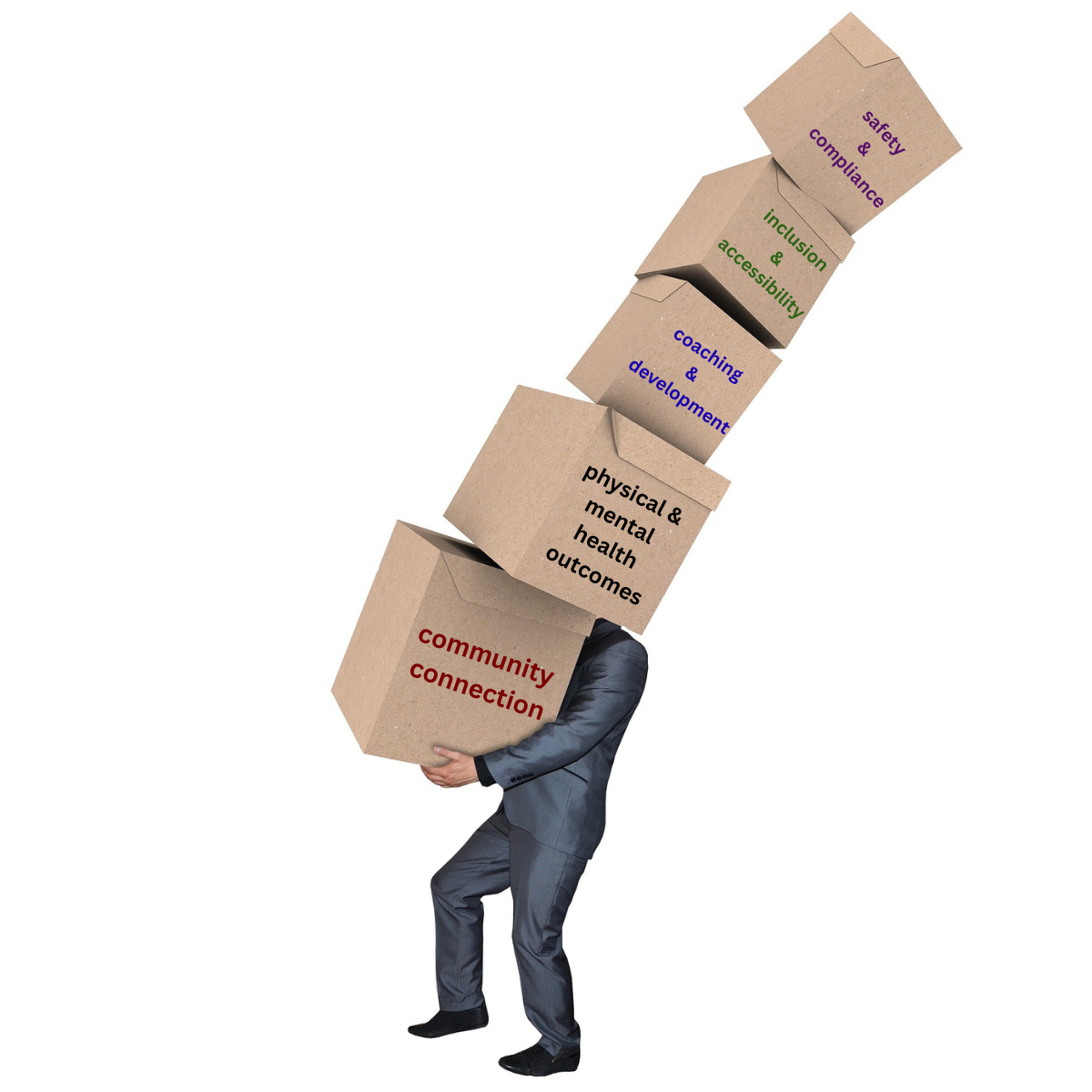
Think about what sits inside that “rock” they carry:
- Compliance and governance
- Inclusivity and accessibility
- Safe sport and risk management
- Accredited coaching and training
- Fiduciary responsibility and financial oversight
- Insurance and liability
- Sponsorship and fundraising
- Physical and mental health outcomes
- Community building and retention
- Diversity, equity, and belonging
- Communication and conflict resolution
That’s not a volunteer role.
That’s an entire industry.
Let’s compare it honestly
If we step back and compare community sport to other volunteer sectors, something becomes very clear.
In faith-based organizations, there are governing bodies, formal training pathways, and centralized structures.
In emergency services, volunteers are supported with standardized training, protocols, funding, and integration into formal systems.
In healthcare, even volunteer-supported roles exist within deeply structured, regulated, and resourced environments.
And yet…
Community sport is expected to deliver outcomes across all of these domains—without the same infrastructure holding it together.
The growing list of expectations
Every year, the list grows:
- “We need to improve retention.”
- “We need to be more inclusive.”
- “We need to prioritize safety.”
- “We need better-trained coaches.”
- “We need to partner with schools.”
- “We need to make sport more affordable.”
- “We need to bring the fun back.”
All valid. All important.
But here’s the disconnect:
We keep adding expectations… without strengthening the system expected to deliver them.
So what happens?
Dedicated volunteers step up. They always do.
They carry more.
They figure it out.
Until, eventually, they burn out… or step away.
And the cycle repeats.
This is the paradigm shift
For me, the shift is this:
Community sport isn’t just a collection of local teams and leagues.
It’s an essential social infrastructure—operating without infrastructure.
Once you see it that way, everything changes.
Because now the question isn’t:
“How do we fix individual problems?”
It becomes:
“How do we connect and support the system itself?”
Connecting the disconnected
Right now, thousands of community sport organizations operate:
- Independently
- With limited visibility
- Without shared tools
- Without consistent access to resources
- Without a clear pathway to connect with participants, partners, or national initiatives
They’re doing incredible work.
But they’re doing it in isolation.
A path forward
If we want real change—sustainable change—we need to stop thinking in silos.
We need to:
- Create visibility so organizations can be found
- Provide access to practical, usable resources
- Enable connection between local organizations, communities, and national initiatives
- Build pathways for collaboration, not duplication
- Support volunteers with tools, not just expectations
That’s infrastructure.
Not theoretical.
Practical. Connected. Accessible.
Where this goes next
This is exactly why I built Sportall.
Not as another program.
Not as another report.
But as an on-ramp.
A place where:
- Organizations can be found
- Volunteers can access tools and resources
- Communities can discover what’s available to them
- Partners can connect directly to the grassroots level
- Ideas, support, and solutions can actually flow—up and down the system
A simple question
If you’ve read this far, you’ve probably felt it too.
That moment where things click a little differently.
So here’s the question I’ll leave you with:
What would community sport look like if we supported it like the system it already is?
Because once we answer that…
We don’t just reduce the weight.
We finally start sharing it.